

The Political Rivalries between Japan and China in the Development of Indonesia’s High-Speed Railway (HSR) Projects
During the presidency of Joko Widodo, there is a
massive shift behind governmental policy and regulations in regards to the issue of infrastructure
development. Whereas the previous president tend to prioritize upon the issue
of economic and political stability, the current administration seems to lenient
more towards the importance of infrastructure
in order to improve both of
Indonesian economic growth as well as its own Global Competitiveness Index. In
regards to this, the President has started to lurk
on foreign investors in order
to achieve his political goal. Example of this
might include Japan and China, which
currently were competing and being at odd with one and another regarding the issue of
‘High-Speed Railway’ or HSR. In this essay, I would argue that the
scheme being offered by China and Indonesia are more feasible; both politically
and economically due to its better
offering compared to the Japanese
one. Taking into accounts on issue such
as financial constrain, global political situation, and their commitments, I
believe that the participation of China rather than Japan would be more beneficial towards Indonesia itself.

This picture was taken from https://asia.nikkei.com/Economy/Indonesian-high-speed-rail-project-stalls-waiting-on-land
On the issue of financial constrain, it might
be seen that the participation of Indonesia
towards this project was lenient more
towards Private-Public Partnerships or PPP due to the lack of governmental budget towards this
project. Even though the government has ensured around Rp280.0 trillion for the
development of economic infrastructure in its
State Budget or APBN in 2016, the
numbers were being considered as lacking; especially when one takes into
account on the numerous amount of projects that would be taken. As such, in order
to push the continuity of this project, the government has pushing for many
options such as increasing the participation of State-Owned Enterprises (SOE),
revising the State Budget or APBN, and looking
out for cooperation; both domestic-sourced and foreign one. China and Japan
were quick to fill this vacuum, and
currently holds the concession of Jakarta-Bandung
HSR and Jakarta-Surabaya HSR respectively.
As has been stated previously, the main focus of
Indonesian government within the projects was centered around PPP models, and
as such the Chinese offering ‘feels’ more compelling rather than the Japanese
one. Whereas the Japanese scheme was being centered on government-to-government policy by involving around the roles of Japan
International Cooperation Agency (JICA); which is the same funders behind Jakarta MRT and Tanjung Priok Access
Toll Road, tends to relies upon
government’s guarantee and was being offered as a form of loans. The Chinese
model was created upon the basis of cooperation
between ‘semi-private’ or private entity, which in this case would give a birth into KCIC (Kereta Api Indonesia-China) as a joint venture between these two countries. The shareholders of KCIC from the Indonesian side are being represented by KAI, WIK, PTPN
VII whereas the Chinese one is being
represented by China Railway International. By doing such approach, the Indonesian
governments has prevents any sort of revision to
its current State Budget or APBN,
and let alone to take another form of
foreign loans.
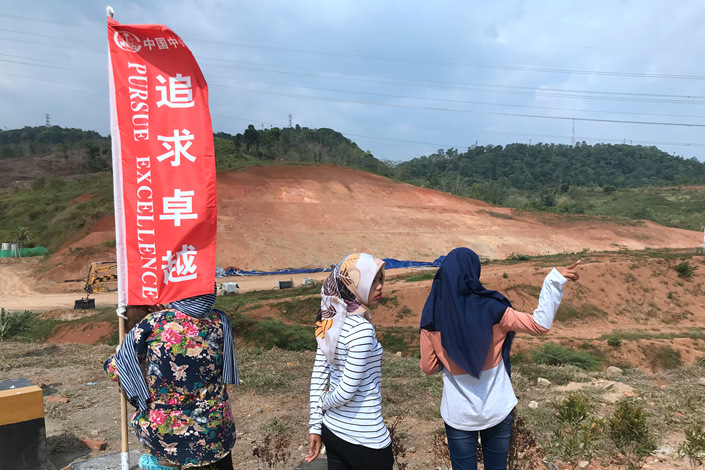
This picture was taken from https://www.caixinglobal.com/2018-10-11/indonesias-china-financed-high-speed-rail-project-off-track-101333896.html
Secondly, on the issue
of global political situation, it might be
seen that there has been a major shift within the Indonesian foreign
policy, especially within the presidency of Joko
Widodo. For example, whereas the previous presidency of SBY tends to take
the matters of foreign policy by its most priority,
the current administration seems to put
more of its focus on domestic matters. This condition has led into a more
‘inward’ looking policy rather than the ‘outward’ looking, as have been in this many recent years. Such conditions
have put Indonesia’s relations with many of its
‘traditional’ partners and investors
such as Australia, United States, and most notably Japan into a difficult
situation. As such, the participations of Japan
in this project of HSR might also being hindered by current state of
Indonesia’s foreign policy directions. Even though Japan still remains one of
Indonesia’s most important trading
partners; currently sits in the 3rd
place both in exports and imports issue, their days were being outnumbered due to the rise of China within the region of Southeast Asia itself. This has led into a major shift of Indonesian
foreign policy, which currently has a pattern towards China.
Due to its rising economic as well as its effort to
spread their influences worldwide; both politically and economically, China
currently has replaced the positions of Japan as one of Indonesia’s most important partners when it came to
the matters of Foreign Direct Investment (FDI), especially in the fields of infrastructure. Across all parts of Southeast Asia, the
Japanese FDI are being outnumbered by significantly, with the exceptions of Thailand and Vietnam. Ranging from smelter construction in Sulawesi to HST development in Jakarta
and Bandung, the roles of Chinese investment in
infrastructure projects which in 2018
has achieved around $23.3 billion are here to
stay and would remain continuing, at least
for the next several years ahead.

This picture was taken from https://en.tempo.co/read/710044/indonesia-china-high-speed-train-project-now-official
Lastly, taking into accounts on their commitment
towards the construction of this project, it might be seen whereas the Chinese
tracks of Jakarta-Bandung have been progressing around 15.03 percent in terms
of construction and 96 percent in terms of land acquisition. By utilizing upon
newer regulations such as Presidential Regulation No. 30/2015,vi KCIC
as private corporations has able to overcome the issue of land acquisition
by which currently has hampered many infrastructure projects across many parts
of the countries. On the other hand, the Japanese commitment towards this issue
were noticeably lacking, considering
their delay of feasibility study from March 2018 into April 2018 and as such
has raised many question whether they would continuing this HSR project or not.
Based upon the analysis above, which took into
accounts on matters such as finance, foreign policy, and political commitment, it might
be seen that the Chinese scheme
on this project far outstrip the
Japanese one; especially when one take into account about its uncertainty for
the future. Within this issue, the
Indonesian government has ‘successfully’ taking advantage of both Japan and
China, while at the same time figuring out which one is the most suitable
one for its own socio-political conditions. It must be noted however, that the Indonesian
government must also take into
account on rising anti- Chinese
sentiment within the significant amount of
its own populations and must ensuring
the public that this project was being funded based upon Private-Public
Partnerships or PPP model rather than constraining the State Budget or APBN itself.
0 komentar:
Posting Komentar